Alien:Derelict No.3 by Chris Foss references plane wreckage fom Tintin In Tibet?


a) September 25th 2017. Looking further through The Adventures of Tintin: Tintin In Tibet (originally serialised weekly from September 1958 to November 1959 in Tintin magazine), I looked at the illustration of a crashed plan and suddenly it starts to reveal in my mind that it served as a starting point for another concept illustration for Alien,  and then oddly I matched it up with Chris Foss' derelict ship number 3


derelict no.3


b) The black angular shadow in a piece of wreckage suddenly shows itself up in my mind as a starting point for the repeating triangular pattern across what might be the ships engines.


c) Perhaps he made use of the dark space with window in the back part of the plane and generally speaking used the effect on the side of the ship as a shadow with a white space

 
d) The propeller blade becomes the large feature on the fin that's repeated on another in the background. They lean towards the same direction in the composition.


e) Propeller blades in the distance become the arrangement of fins on the top of the derelict. There are also the tale fins of the plane to consider in the illustration and one might consider the result to be a merger between these  ideas


Jack Kirby's Lemurian Train bomb references Felt Pen Drawing (work 147) by Giger

leading from
 
detail from drawing by Giger from 1971 and front of Kirby's Lemurian train bomb (1977)


a) Jack Kirby appeared to  like the shapes from Giger's (work 147) but getting to that point one might take a look at how this certain drawing by Giger was inspired by the vacuum cleaner drawing from "Our Man From Havanna" and then become enthusiastic about horizontal vacuum cleaners on sale and then start to think that Kirby's Lemurian train bomb was in on what was behind Giger's drawing and then draw a vehicle that was almost just a futuristic looking vacuum cleaner.

(See also: Alien: From "Our Man In Havana" to the Derelict Ship exterior)

Lemurian Train Bomb

Felt Pen Drawing by Giger (work 147) (1971)


b) Perhaps also one might consider that horizontal vacuum cleaners were looking more and more like futuristic spaceships or trains.


Electrolux Silverado Deluxe canister vacuum circa 1972 to 1975
( source: http://breakingyard.blogspot.co.uk)


HR Giger : The Spell IV: What has been firmly established

 
leading from 
and

a) In 1975, HR Giger had started drawing of a design featuring a woman in a pentagram sitting upon a Baphomet, and also painted Baphomet (after Eliphas Levi) following the same idea that year with the female and the Baphomet as part of a rail car.

This extreme leaning towards definite occult symbolism appears to come about because his friendship with Sergius Golowin who understood a lot about occult and mysticism. While Giger had an interest in these things, he didn't practice it, but he basically was interested in the big topics of the soul that were there, being sexuality, redemption and power. (See Sergius Golowin introduces HR Giger to the work of HP Lovecraft)

He then went on to paint The Spell IV in 1977 as part of The Spell series that formed a four sided environment to stand within.


Baphomet sketch (1975) by  HR Giger
 
Baphomet (after Eliphas Levi) (work 272) (1975) by  HR Giger

b) What came out of The Spell IV (as told to Carmen Giger which she mentions in an interview with Another Man Magazine) was the idea that the light and dark snakes were mythological reference to the fall of Adam and Eve, that the painting  symbolized humanity's quest for  enlightenment and with that the Baphomet symbolised humanity's position between the animal kingdom and the divine.

This Baphomet appeared to be based on the 19th century image of a Sabbatic Goat, created by Eliphas Levi. Giger had painted the composition using his gut instinct, and without thinking.

  1. Carmen Giger: His fascination with the occult came from Sergius Golowin, a writer and close friend he met just as he was starting work on his Necronomicon book. Golowin knew a lot about the occult and mysticism and introduced Hans to people like HP Lovecraft and FM Murer. The light and dark snakes he used in his Spell paintings for instance, were a mythological reference to the Fall of Adam and Eve. Spell III [1976] symbolises our quest for enlightenment with Baphomet symbolising humanity’s position between the animal kingdom and the divine. (https://www.anothermanmag.com/life-culture/10934/alien-film-hr-giger-ridley-scott-anniversary-artist-carmen)
  2. Carmen Giger: His interest in the occult is clear because the big topics of the soul are there: sexuality, redemption and power. But he never practised these things, he had a really good centre.  (https://www.anothermanmag.com/life-culture/10934/alien-film-hr-giger-ridley-scott-anniversary-artist-carmen)
  3. HR Giger: The idea for the Baphomet came from the guts. I did it quickly without thinking. (Cthulhu Sex 19 2) 
illustration by Eliphas Levi

HR Giger: The Spell IV references George Melies' "20,000 leagues under the sea"


leading from 


The other source of inspiration would have been images from George Méliès ' 1906 movie "20,000 leagues under the sea" with a scene dominated five pointed star and women posing around the picture, some with lower bodies transformed into tentacles ending with fish tails


HR Giger: The Spell IV references Fritz Lang's Metropolis?


leading from 
HR Giger's The Spell IV (1977)
and
Metropolis

a) On the 12th July 2015, it immediately strook me about this painting, that the way the woman is held up in the air as a pale figure who might as well have been a circus performer doing a show and then it brings me to cast my mind mind back to a scene in Fritz Lang's 1927 movie Metropolis where as a stage set piece, the female robot disguised as a human woman does her dance as the whore of Babylon. 

Giger's painting was completed in 1977 which would have been the fifty years after Fritz Lang's movie. 

So there went the flow of thoughts.  

There are seven serpentine forms that would be the serpentine heads of the seven headed beast, the seventh in this case lurks in the very back of the mid right of the painting as several forms merged into one behind the three snakes. 

However in Giger's paintings the tongues flames streaming out from either side of her seat become transformed into the serpents. 

In the illustration in the film, it seems as if the two tongues of flame on the left were the horns of the most prominent serpent at the front, and a few of these heads had two horns each. 

It might have served Giger with the inspiration to imagine a Baphomet taking centre place.


b) A vast basin holds the seven headed beast upon which she sits, and one of the bearers who are the seven deadly sins, is a woman exposing a breast. 

However Giger perhaps, puts its head in the place of Baphomet's own breast and transforms the figure into the imp holding a hand grenade in that place, while sitting on Baphomet's lap.


c) The bone framework architecture in that case might be loosely reminiscent of the towering skyscrapers of Metropolis at the side but turned into bone, as can be found in the other paintings of the series. And perhaps the metal girder upon which the Baphomet sits was roughly inspired by the bridges going between the buildings. Angular parts sticking out of the central building could also have set off the association with a pentagram in Giger's mind.


d) Inverted pentagram in Metropolis
Behind the seat of the android, there is a large inverted pentagram in the background on the wall. And also an upright pentagram on the doorway of the house of the man who creates the android


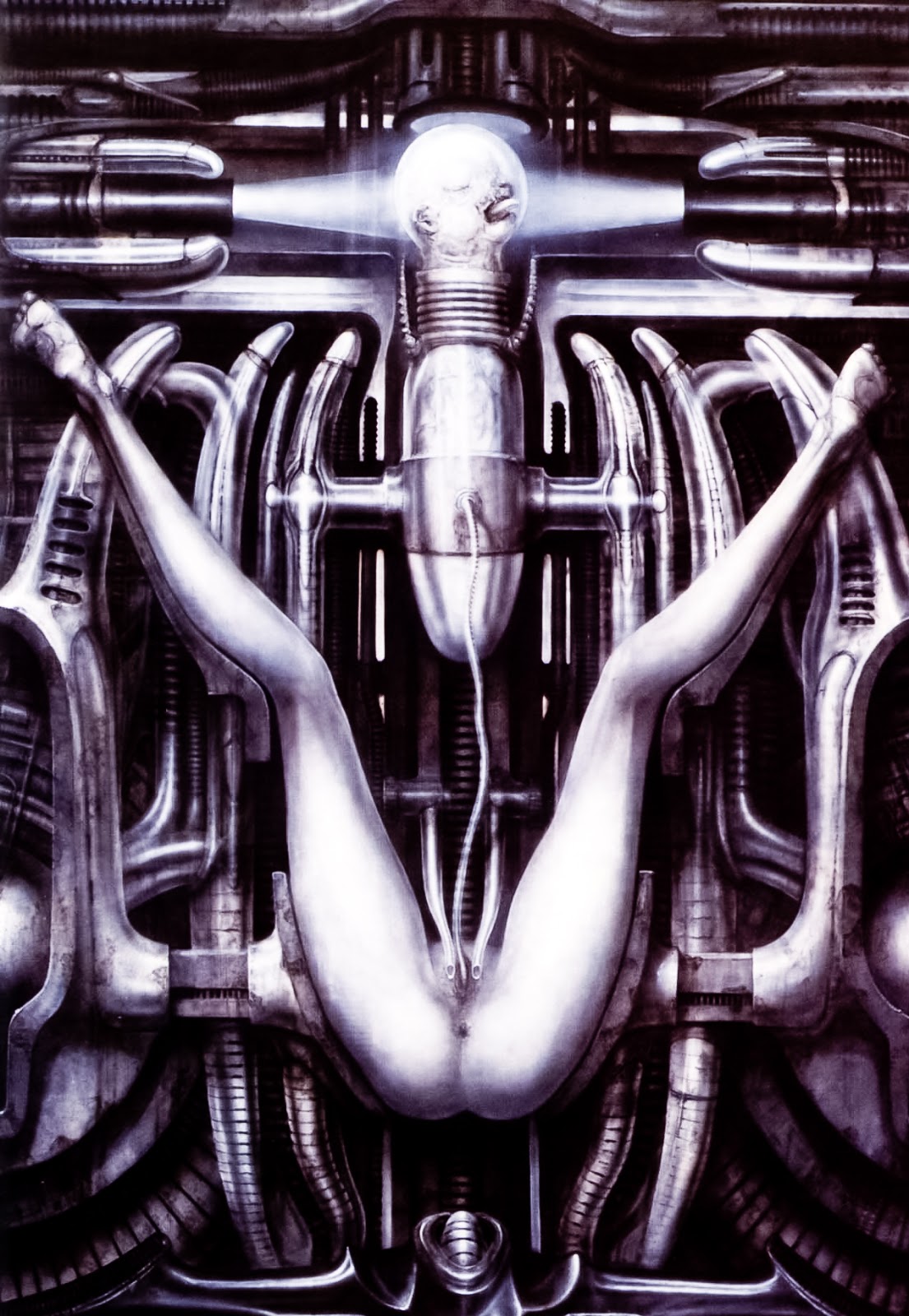
Giger's Stillbirth Machine III - (Homage to David Lynch?) (1977) and comparison to works by Ernst Fuchs?

leading from

Giger's Stillbirth Machine III (1977) (work 355)


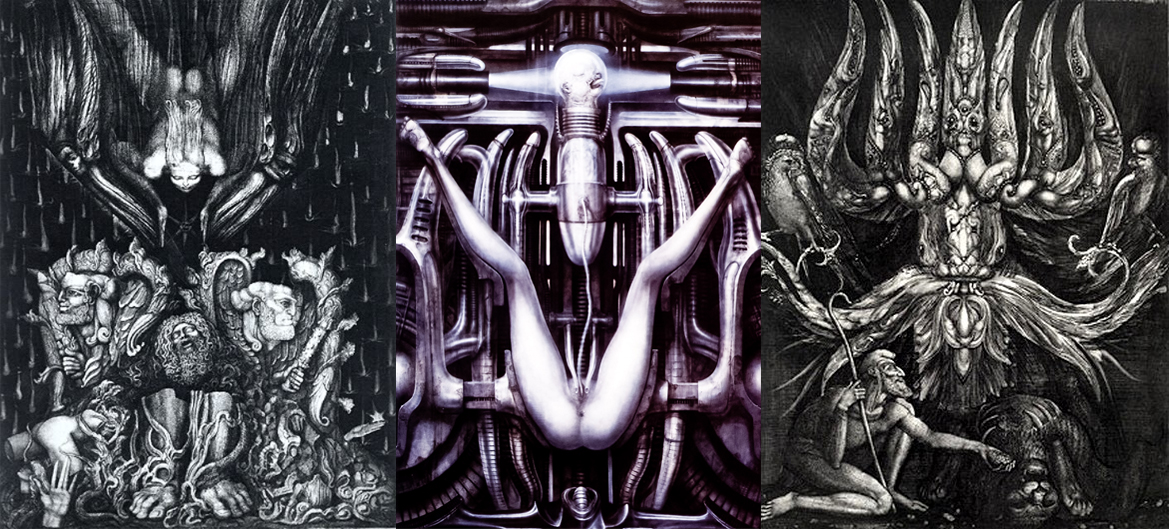
a) Comparisons to Ernst Fuchs "Samson finds the carcass of the lion" (1961)
Giger's Stillbirth Machine bears similarities to Ernst Fuchs "Samson finds the carcass of the lion" from 1961. What there is to point out here that we have a series of vertical phallic prongs like some sort of a candelabra.

Ernst Fuchs  "Samson finds the carcass of the lion" (1961)

b) Comparisons to "Adam's Destruction and Promise"
I would also make the suggestion that Giger went ahead and merged it with ideas inspired by "Adam's Destruction and Promise" which shows angels wings in the form that resemble inverted parted legs and above the glowing human body that may have been transformed into the exterior mecahnical womb

Ernst Fuchs "Adam's destruction and promise"

Ernst Fuchs "Adam's destruction and promise", Giger's Stillbirth Machine III and Fuchs "Samson finds the carcass of the lion"


c) Another version of "Adam's Destruction and Promise"
Painting by Fuchs from Omni Magazine showing the same sort of content as Ernst Fuchs "Adam's destruction and promise" with multiple winged form in the air (undated)


A painting by Ernst found in Omni Magazine (source http://snodge.tumblr.com/post/)
d) Homage to David Lynch!?
It's the 7th of June 2019, and I've noticed in a document "L’HORRIBLE : UN MOUVEMENT ARTISTIQUE Le regard moderne de HR Giger by Laura Wojazer  that this painting's name has changed slightly with "Homage to David Lynch" added.  (see: https://docplayer.fr/13468232-L-horrible-un-mouvement-artistique-le-regard-moderne-de-hr-giger.html)
 
Giger had traveled to New York at the end of 1977 to take part in an art exhibition. the film Eraserhead was being shown. Of course, he went to see it at the advice of Mati Klarwein, and loved it. (See "b) Advice from Mati Klarwein while in New York" in Alien vs Eraserhead)

The fetal head in the painting is barely visible but it almost animal like almost like the idea of the baby in Eraserhead, and perhaps he painted it from memory. With that, the painting was created towards the end of the year and so the association falls into place.