Prometheus: Babylonian starmap tablet

leading from
and
 
 
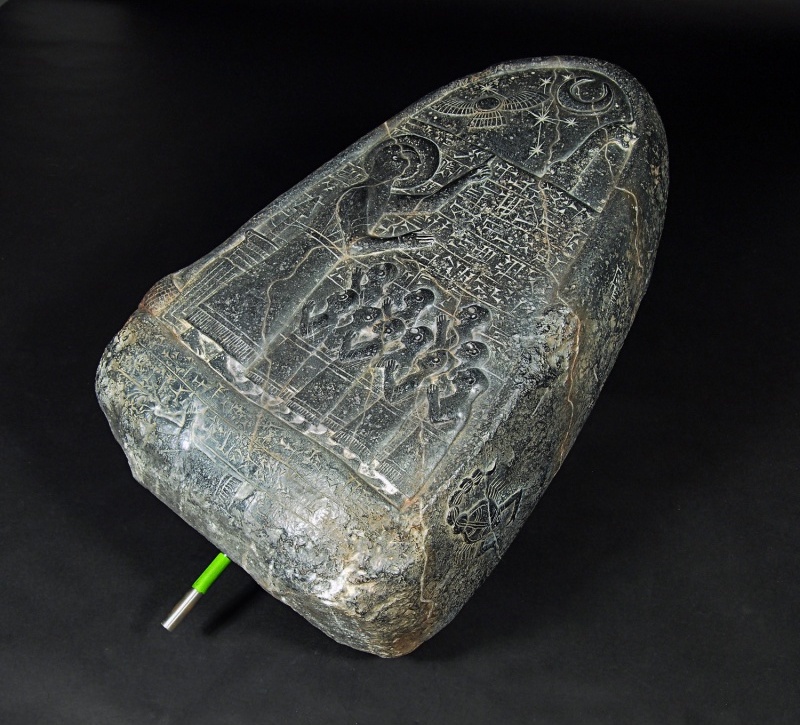
a.i) This is one of the tablets from the Sci-Fi adventure Prometheus. The tablets are gathered as evidence to prove that the Ancient Aliens, known as Engineers existed. It is observed most notably in the scene where Dr Shaw (Noomi Rapace) and Dr Holloway (Logan Marshall-Green) are briefing the crew on the reason why the tablets will lead them to find proof of Ancient life on planet LV-223.

The tablet has a flat base and is oval in shape at the top. The images depicted on it include the star map which is analysed during the film. This rather large prop is hollow, made of hard plastic and has a resin skin on the outside which has been carved and painted to resemble a dark grey stone effect. The bottom of the tablet has been given slightly broken effect which gives the impression that it was part of a larger rock at some point. Underneath a green painted pole is inserted into the tablet, which would have been edited out to give it a suspended appearance in the holograms.

This extraordinary piece measures approximately 87cm x 55cm x 14cm (34.25” x 21.75” x 5.5”) and is in superb condition. (https://www.propside.com/en/ancient-engineer-star-map-tablet-prometheus-2012-p-110.html)


a.ii)


a.iii)


a.iv)


a.v)


a.vi)


a.vii)


a.viii)


a.ix)


a.x)


a.xi) 


b) Babylonian starmap as it appears in the film


c) The front is loosely based upon a Babylonian stela found at the British Museum, (c.a. 900BC-800BC)? Most noticeably, with the addition of the star-map, the figures have been altered so that there are nine figures giving praise to the tall figure that tha on

 "Commemorative stone stela in the form of a boundary-stone (kudurru): the stela consists of a small boulder, on one face of which a fiat panel has been sunk, leaving figures and symbols standing out within it in low relief. The greater part of the inscription has been carved upon the flat surface of the panel, but the last seven lines extend below the panel to the base of the stone. The stela is set up in honour of Adad-etir, the dagger-bearer of Marduk, by his eldest son. The name Marduk-balatsu-ikbi, which occurs in l. 4, is that of Adad-etir's son, not the name of the king to whom Adad-etir owed allegiance; and the two figures standing on the lower ledge of the panel represent Adad-etir and his eldest son, not Adad-etir and the king. The stele is closely related to a kudurru, since it is protected by carved symbols and by the addition of imprecatory clauses to the text. These symbols include (1) winged solar disc; (2) crescent; and (3) lion-headed mace upon a pedestal." (https://www.britishmuseum.org/collection/object/W_1881-0428-1084)


d) The back is based on a boundary stone, or kudurru, records a gift of land made by Eanna-shum-iddina:

"Limestone kudurru or boundary stone: consisting of a boulder of dark limestone, the faces of which have been slightly flattened by rubbing in order to take inscriptions and sculptures in relief. The stone tapers rather more towards the top than towards the base. The upper portion of the Obverse, for a space of 9 1/4 in., and the right side and part of the left side of the stone, are engraved in low relief with a series of emblems, the greater number of which are arranged within two registers separated by plain bands. Faces A and B, Upper register, (1) Solar disc, (2) Crescent, (3) Eight-pointed star, (4) Horned headdress upon a shrine, (5) Horned headdress upon a shrine, (6) Turtle upon a shrine, (7) Twin spirals upon a shrine (the spirals here curl inward and spring from a stem, thus presenting striking differences from the so-called inverted yoke), (8) Wedge upon a shrine (the thicker end of the wedge is here indented, and its face is ornamented with a decorative band), and (9) Spear-head upon a shrine; Lower register, (10) Lightning-fork upon a shrine, (11) Lamp upon a shrine, (12) Yoke upon a shrine, (13) Scorpion upon a shrine, (14) Dog upon a shrine, (15) Lion-headed mace a upon a shrine; below the second register on Face B, (16) Sheaf of corn upon a shrine; Left side and top of stone, (17) Serpent. The emblems in the Lower register are separated from the shrines on which they rest by a plain band. Below twin spirals, wedge upon a shrine and spear upon a shrine in the Upper register the engraver has left a similar band, but there he has cut it into sections, each of which forms a base for an emblem or a heavy cornice for its shrine. The lower part of the Obverse and the whole of the Reverse are devoted to the text, which records a deed of a gift recording a grant of five 'gur' of corn-land, in the district of Edina in Southern Babylonia, to Gula-eresh by Eanna-shum-iddina, governor of the Sea-Land. The estate is described as bounded by Bit-Iddiatu, the estate of Amel-Marduk, the province of the Sea-Land, and the Edina-Canal. The surveyor was Amurru-bel-zeri, and the transfer was completed by Zakiru and Adad-shum-ibni, two high officials.(https://www.britishmuseum.org/collection/object/W_1907-1014-1)
 

(Source: https://www.worldhistory.org/image/6975/boundary-stone-from-mesopotamia/)


Alien Covenant: Wayne Haag's shell like cathedral entrance


leading from


Shell like entrance of the building by Wayne Haag, with mural on the inside wall.


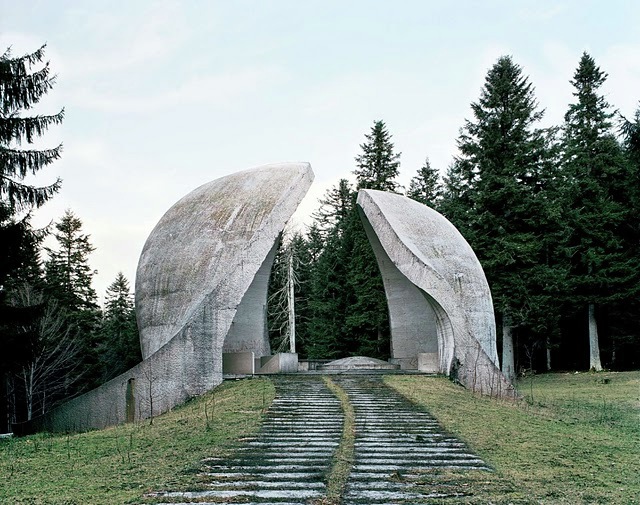
a) The entrance of the domed cathedral without doubt references the Grmeč Monument to the Revolution, built in Yugoslavia and completed in 1979, to the point of it being used lock stock and barrel.

Grmeč Monument to the Revolution, completed in 1979, designed by Ljubomir Denković


b) When it came to the inside wall of the shell, Chris Seagers the production designer  near enough said "Can you get some artwork in there?", gave him some art, and into the composition Haag's inserted "The Body of Christ Borne to the Tomb", (1799-1800) by William Blake which is to be found at the Tate Britain.  People interested in the film might wonder what it all might mean, but for Wayne, it was a case of taking something and using it. Reflecting on the matter Ev Shipard wondered if there was something to the artwork being given to then as themes to reflect on in the film but he wasn't privy to that sort of information. The woman in a white veil has been pasted on either side of the door itself.


William Blake's illustrated on the inside wall of the entrance

"The Body of Christ Borne to the Tomb", (1799-1800) William Blake (Source: Tate Britain)

  1. Wayne Haag: It's a nice little homage to the erm, creative designer of the front door that opening sort of broken shells sphere, which is you know the er, over the stairway of the cathedral.

    Clara Fei-Fei:
    Oh yeah, the er er, er, it's from erm, former Yugloslavia, that was erm
    Grmeč sculpture.

    Wayne Haag: Yeah, some Soviet era you know sculpture which really is like lock stock and barrel.

    Ev Shipard
    : I'm quite proud of that, There is also the constellation on the on the walls on the door, the artist, um I can't remember the artist's name, ah.

    Wayne Haag: Ah um, Yeah, yeah.

    Ev Shipard: Such a long time.

    Wayne: Yeah it was on some of the reference.

    Ev Shipard: Yeah

    Wayne Haag:Things like, things like that for example, like the inside of that shell, that was, you know, one of the things I had to throw in there. Chris just said, can you get some like, some art work in there, so here's a bunch of reference, some big one.

    Clara Fei-Fei: Oh yeah, William Blake.

    Wayne Haag: If you're into this stuff, it's like oh my god, there's a story there, what does that mean?! What does that mean!? It's just some piece of art I've just picked up from, from the reference folder that I've been given. I'm just like, heeyah, I'll use that one.

    Ev Shipard: But then you think after the fact, but maybe that meant something, maybe that's why why it was there, kind of like St Bartholemew. Ridley's like this is the reference, this is the reference, make it look like the engineers, Okay, off we go.

    Wayne Haag: Maybe.

    Ev Shipard: Sculpt it up, maybe afterwards, okay this is really interesting how this points to the whole story. Is it because it looked right visually, or is there another level that, that , that the powers that be have decided upon. It's you know, it's up to us to integrate it, make sure it works visually within the uh, the concept art that often, you know, we're just not privy to that stuff . You can hypothesise about it. It's purely our opinions but, but were just not privy to that. ( From: Yutani Podcast: Creatives: Wayne Haag and Ev Shipard – Episode 15 ,   10/08/2018, see 1 hour and 25 minutes into it )

Carlos Huante


a) Working on Prometheus


a.ii) See: The Ultramorph


 a.iii) See:  The Engineers


 a.iv) See: Facehugger centipede


a.vii) See: Babyhead


a.viii) See: Origins of Babyhead 


a.xi) See: Prometheus notes


b) Working on Alien Covenant


Alien themed personal work

d. i) See: Pilot


d.ii) Red Bullbox alien


Alien Covenant: Grmeč Monument to the Revolution referenced for the domed citadel entrance?

leading from


Grmeč Monument to the Revolution, completed in 1979, designed by Ljubomir Denković
 
a) Emirhan Eren who liked to post about Brutalist architecture, in August 22nd, 2017 posted on Twitter his realisation that the entrance to the domed temple was based upon the Grmeč Monument to the Revolution

  1. Emirhan Eren:1. "Cathedral" Alien Covenant, design by Steve Messing, 2017 2. "Grmeč" Spomenik in Bosina, design by Ljubomir Denković, 1979"
    (https://twitter.com/emrhneren/status/900030510138896384?lang=en-gb )

b) The Spomenik database responding to this find were able to document the similarity between the Grmeč Monument to the Revolution and the domed temple entrance
  • "Interestingly, a likeness of the monument was used in concept artwork for the 2017 Hollywood film 'Alien: Covenant' ), in which the Grmeč sculpture is depicted as some nature of alien temple." (http://www.spomenikdatabase.org/grmec)
  • "The shape of the memorial complex here at Grmeč appears to symbolize a newly breaking flower bud (Photo 5), which is itself may be a representation of newly emerging freedom and 'birth' brought about by the sacrifice of those who fought and died here. In addition, the interior of the bud is intended to represent the very heart of the Grmeč forest, where the hospital that operated here toiled to keep wounded soldiers alive. Meanwhile, the 'flower bud' shaped structure is juxtaposed by a circular pool --  this positioning may be meant to symbolize a dualistic relationship, with the blossoming of the 'flower bud' up from the earth representing 'life' and 'freedom', the adjacent pool symbolizes all those soldiers who fell and succumb to the violence of war."(http://www.spomenikdatabase.org/grmec)

c) Here we find that Steve Messing replacated the Grmeč Monument to the Revolution as the entrance to the temple in a piece of concept art.


messingart: Alien Covenant Temple (source: https://www.instagram.comt)


 d) See: Wayne Haag used the shell like form in his entrance for the domed building

Shell like entrance of the building by Wayne Haag, with mural on the inside wall.

e) The idea was used as the in the final building as seen in the film as well as the shell like entrance.


The large citadel in the engineers city which contains the Hall of Heads

f)  Having my realisations
Many thanks to Clara Fei-Fei of Yutani Corporation on Facebook who, having taken note of a retweet of a Twitter post in July 2017 featuring a link for "23 Forgotten Monuments From The Former Yugoslavia",  and taking an interest in general in these building structures went forth to buy the book "The Spomenik Monument Database" and on October 7th 2018 show photos of a selection of pages from the tome on her Facebook page, showing some examples of Croatian Brutalist Art including the Grmeč Monument to the Revolution ( https://www.facebook.com/yutanicorporation/  ) . I then recognised the structure realised that I had seen the connection made last year on Twitter by Emirhan Eren, liked it and forgot about it, but this day pulled the pieces together . (https://twitter.com/emrhneren/status/900030510138896384?lang=en-gb ) 

I had heard Clara Fei-Fei's Yutani Podcast #15 in August 2018 discussing this entrance but I wasn't able to spend time to sit down and work out what was being actually discussed in relation to this but on October 8th I sat down and listened to the podcast again, Grmeč isn't easy to pronounce and Wayne Haag then stated that it was a Soviet era sculpture became another blur since Yugloslavia had broken up with Russia back in the 1940s and Brutalist architecture started later, it probably wasn't up to him to know about the thing in detail anyway when he used it as reference.


Alien 5: ADI Alien maquette

leading from


a) Neil Blomkamp reveals an alien maquette :


b) Joe Rogan's Mascot (https://www.instagram.com/p/CYcuatJMl6_/)
  1. Joe Rogan: New studio mascot. (Instagram January 8th 2022)


c) From Carlos Huante's illustrations released Alien 5 illustrations, No.7 corresponds the most to this  one the most.
 
It's diminutive extra set of arms coming out of the side of the chest underneath the main arms.