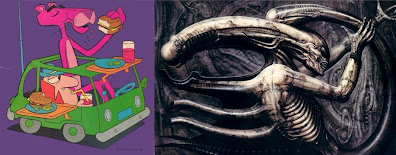
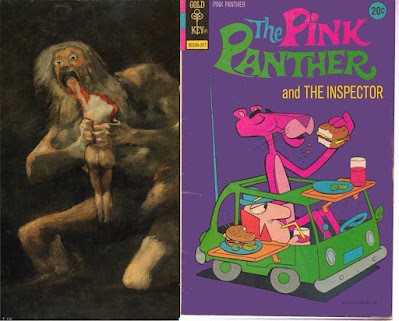
Giger's The Spell i, ii, iii & iv

leading from

a) See: The Spell I  (work 237) (1973-1974) (Monolithic vessel inspired by the Cristo Redentor of Rio De Janeiro with echoes of "Jesus Christ Superstar" merged with Egyptian dwarf god Bes journeys into the stargate)


b) See: The Spell II (work 238) (1974) (Mad magazine fold-in, Mike Oldfield's Tubular Bells and Virgin record label)


c)  See: The Spell III (work 320)  (1976) (Takeda Shingen's head dress) 


d) See: The Spell IV (work 331) (1977) (Eliphas Levi's Baphomet, Lang's Metropolis , Melies' 20,000 Leagues under the sea and Jack Kirby's The Master Eye from #3 of The Demon?)


HR Giger's Mordor XII (1976)

leading from
a) (28th December 2015). Someone might have the flu. Is this about someone inhaling steam from a steam inhaler because of a severe cough or a bout of flu, and perhaps the device is also the trumpet of a gramophone player that's turning into a unicycle? Where the coughing reptile's beak ends along with the tip of what  might be a thermometre that has undergone a transformation into a curling work, and the grey bulbous tip where the mercury is contained becomes the opening of a nostril  while the fleshy surrounds becomes the the tip of the nose. The head of a Cthulhu like being with a face full of tentacles becomes a blanket or towel wrapped around the head.


b) (28th December 2015) The beaked face appears to resemble a skull he painted for National Park  from the previous year being 1975, which has the back of the mouth begins with teeth and then continues to the top as a beak


Beaked heads from Mordor XII (1976) and National Park  (1975)


c) References illustration from Linda C. Cain and Susan Rosenbaum's "Blast Off" (1973) by Leo and Diane Dillon ?

https://alienexplorations.blogspot.com/2020/06/illustration-from-illustration-from_7.html


d) HR Giger: Mordor XII (1976) references Francis Bacon's Study For A Bullfight no.1 (1969)?

https://alienexplorations.blogspot.com/2020/06/hr-giger-mordor-xii-1976-references.html


Giger and his biomechanoid world.

leading from

Still collating

a) Artistic influence
If one is looking for complete originality in Giger's work, he would admit that his work was not entirely new. He had been influenced by Anton Gaudi, Alfred Kubin, Salvador Dali and first and foremost, Hieronymous Bosch. When he did his work, everything would influence him and it would go directly into his work. His art was a kind of diary that he had no control over. He would have a strong idea and then out it would come in the picture. He would compare the way it happened to a seismograph.

b) The world of his paintings
The world that would show itself in his work, he thought, could be another place in this world, or another world in space, or perhaps the future. There were visions of sickness and death in his work, he didn't like the idea of this sort of thing but he accepted that it was in his paintings

c) Environment suit
Giger talked about the idea of his biomechanoids when interviewed the documentary "Alien Evolution",  in relation to the Necronom paintings. He stated that he wanted to make something that would be somehow human but that would also be robot-like, a kind of human that is protected from all kinds of external forces, be they weapons, radiation, or whatever else. Instead of having their bones on the inside, they have them, partly at least, on the outside like an exo-skeleton, so the idea was also brought forth in another version of the translation that they were indeed protected by a suit of bone. He mixed the ideas together, his world of bones along with technical structures, and that's how the biomechanoids came about, from the interplay between the ideas of biological and the mechanical. There was also the time he saw his mother linked up to hospital machinery and would have hip implants for her hips, this would help him see a way that technology could benefit a human and thus closer integration between the human and technology could be a good thing just as prosthetic limbs provide aid for a human being.

d) Transforming apparitions
Some of these biomechanoid apparitions would be made up from vaguely recognisable elements from various ancient mythologies, sculptures, descriptions from novels and various other pictures that he admired. For example The Fisher Price Cot Activity centre bizarrely served as a starting point for Passage Temple Entrance.

Necronom IV which inspired the creature design in Alien appeared to be inspired by the lit parts of the face of Steiner-Prag's golem illustration, decorated with elements from an ethereal painting by Ernst Fuchs of a sphinx, and transformed into an Egyptian Eye of Horus, while Necronom V turned out to be an assembly of folk art sculptures from Easter Island merged with a female version of the human figure from Pakal Votan's tomb lid, turning her into a motorcycle rider pierced through the back by a passenger's body, and her head merges with one of the tusk like forms on the tomb lid to become an elongated head so well known as the head of the beast of Alien. The way this apparition stretches out across the picture in two levels might bring one to recall Dali's Soft Construction with boiled beans (Premonition of a Spanish Civil War).

Meanwhile other Steiner-Prag illustrations from the Golem would serve as the foundations for a few other of his painting. The arches, railings and stairs in Steiner-Prag's Golem drawing "Vice" overlayed by his drawing "Aaron Wassertrum" featuring a Jewish man with a large nose wearing a hat sitting in front of his junk shop with its intricate detailed junk over the door are transformed into jet fighter pilot like humanoids merged with the breathing apparatus and mechanisms of their vehicles in Giger's Biomechanoid II. Necronom III would reveal itself to be a perhaps a humanoid in a Lancaster Bomber gunner pod that slowly was transforming into Max Ernst's painting Celebes.

In Mordor IV, we find chains of transforming thoughts,  we find that a mermaid has been transformed into a manatee-manitou-mantaray, but instead of the manatee he has given us a sealion, instead of the manta-ray he has given us a sting-ray mouth, and instead of the manitou, he has given us some phantom of the Enigma of William Tell merged with the lead singer of Jethro Tull in one of his poses , the face with the singers eyes popping out as he blows away as a saxophone performing the songs of the album Aqualung and the saxophone itself becomes an ancient aqualung in itself.

Australian aboriginal cave art has turned up in paintings, such as the central figure of Assuan and the stick like figures imbedded in Biomechanical Landscape (1976)

e) Giger the bee
The way that Giger chooses the works that would be his starting point and then his brain stretches and transforms the source images to become what they are on the canvas hold an undeniable secret. Giger's friend Bijan Alaam knew that Giger was a great reader of esoterical, paraesoterical and Egyptian mythology books,  and saw how he was working away like a bee, taking nectar from many visual and literary flowers, absorbing the various elements and integrating them in his very unique and personal style as if he transforms them into his very own honey.

f) An open mind about these things
The end result of these things however they were to be described would just be characters turned out to be biomechanoids which had a robot like quality, perhaps the golem lays at the foundation of many of these biomechanoids, perhaps there are the Doctor Who biomechanoids such as Cybermen, Ice Warriors and so on from distant planets, but Giger has evolved them into creatures of his own world, and that may be a very distant world indeed. However whatever was created was always going to be the product of the human imagination and it doesn't hurt to have a jovial dislocated point of view about what goes on in his works, as much of what he is trying to draw or paint arrives from such dislocation, although within his style and way of thinking.

g) Incorporating bones into sculptures and furniture
With sculptures and furniture, he would be content to incorporate actual human bones into it. Bones would give him ideas for organic forms. There were the human skulls that came from India that he used for the sculpture of the Alien beast. Later in 1980, Giger went as far as to obtain eight complete human skeletons from India and plans to incorporate them into chairs. His idea was that these people would rather be integrated into his furniture than be nameless in the grave. And strange skeletons of one sort of another would turn up at his house to be used one way or another.

Source Quotes
  1. Giger: These paintings, Necronom 4, 5 and earlier ones too, they came about as follows: I wanted to make something that would be somehow human, and yet, would also be robot-like, that is to say a kind of human being that is protected from all kinds of alien influences, be they weapons, or from radiation or from all kinds of things. Some kind of beings from whose appearance it's obvious that they've experienced something or other, and who in fact, instead of having their bones on the inside, they have them, partly at least, practically on the outside like an exoskeleton, and well, bones and ribs and simply all kinds of bones have always held their great fascination for me, because of their organic character and their affinity to Art Nouveau of which I am very fond , and I mixed these together, this world of bones, I mixed it with technical things; that's how these biomechanoids came about, that is from the biological and mechanical, and interplay of the two. And my characters turned out to be these biomechanoids which actually have a robot like quality, they could have been from another planet. And since I made that ET for Freddy Murer in '69, I was still interested in the idea: what it would look like, if life from outside of us, what would that look like. The idea that another civilisation , other technical possibilities, well simply, what would that look like. And of course that's so tremendously.... the possibilities are so varied and great that one has to constantly remind oneself this creature had actually come from the brain of a person from this planet, and so it is very human; it isn't possible to make anything extra-terrestrial, since everything is created in our brain and thereby remains very human. (From a report of what Giger said in his interview with Alien Evolution)
  2. In the long version of Alien Evolution his words in Germans are translated into English subtitles that read "I wanted to make something that would be somehow human but that would also be robot-like, a kind of human that is protected from all kinds of external forces, be they weapons, radiation or whatever else. Instead of having their bones on the inside, they have them, partly at least, on the outside like an exo-skeleton. I mixed these together, this world of bones , mixed it with technical things, that's how these 'biomechanoids' came about from the interplay of the biological and the mechanical."       
  3. In the shorter version of Alien Evolution, the man who does an English voice over during the Giger's section saying "I wanted to make something that would be somehow human but that would also be robot-like, that is to say a kind of human being that is protected  by bone. And I mixed these together, this world of bones , I mixed it with technical things, that's how these 'biomechanoids' came about, that is from the biological and the mechanical interplay of the two." 
  4. Bijan Aalam: As I said, like a bee he absorbed elements from many visual and literary flowers and integrated them in his very and unique personal style. Go on finding his sources, which means discover all the various flowers he made his honey with. It' s highly interesting. (Facebook18th March 2015)
  5. Bijan Aalam: He was always very much interested in esoterics, especially egyptian mythology. and was like a bee, taking samples from many flowers and transforming them into his very own honey. (Facebook 17th March 2015)
  6. HR Giger: My stuff is not completely fresh. I have been influenced by Gaudi, Kubin, Dali and, first and foremost, Hieronymous Bosch. When I do my work, everything influences me, it comes directly into my work. (Clive Barker's A-Z of Horror) 
  7. HR Giger: My art is kind of a diary that I have no control over, I have a strong idea and it comes out, as on a seismograph. (Giger Rhymes with 'meager'—which Describes the Normalcy in This Oscar Winner's Weird Life. By Dawn Maria Clayton, June 16, 1980, Vol. 13 No. 24By Dawn Maria Clayton (http://www.people.com/)
  8. Giger has also obtained eight complete human skeletons from India and plans to incorporate them into chairs. "These people would rather be integrated into my furniture than be nameless in the grave." Understandably, the Gigers rarely entertain at home.  (Giger Rhymes with 'meager'—which Describes the Normalcy in This Oscar Winner's Weird Life. By Dawn Maria Clayton, June 16, 1980, Vol. 13 No. 24By Dawn Maria Clayton (http://www.people.com/people/archive/article/0,,20076731,00.html
  9. A Giger scene "could be another place in this world, or another world in space, or it could be the future," he says. "I hate sickness and death. But these things are in my paintings.(Giger Rhymes with 'meager'—which Describes the Normalcy in This Oscar Winner's Weird Life. By Dawn Maria Clayton, June 16, 1980, Vol. 13 No. 24By Dawn Maria Clayton (http://www.people.com/people/archive/article/0,,20076731,00.html


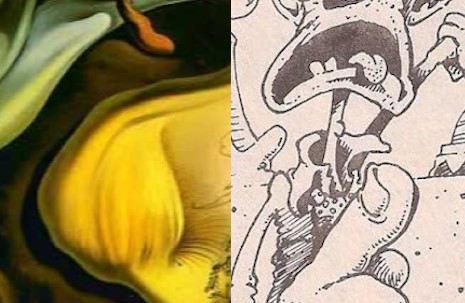
"Dogman in Doktor Oktorpus Nonplussed" from p 28 of Dennis Gifford's Ally Slopper #1 (1976) drawn by Hunt Emerson

Panel from ""Dogman in Doktor Oktorpus Nonplussed" references Salvador Dali's Daddy Longlegs of the evening - Hope" (1940) ?


 leading from
"Dogman in Doktor Oktorpus Nonplussed" from p 28 
of Dennis Gifford's Ally Slopper #1 (1976) drawn by Hunt Emerson


a) Panel from Dogman


b) Dali's "Daddy Longlegs of the Evening - Hope!" (1940)

http://alienexplorations.blogspot.co.uk/1979/07/dalis-daddy-longlegs-of-evening.html


c) The area of the painting that becomes the dogman's head


d) The cherub becomes hand


e) The figure in the distance becomes the centre of the eyes


f) Looking further down along this area, perhaps we have an area for the whole head and with this we might see how the red stamen like form becomes the tongue ,


g) The red stamen becomes a tongue


h) The gap between the drooped orchid like form  that might as well be an organic bi-plane and the sleeping yellow head becomes the open mouth.

The closed eyelid becomes the finger


i) The ink pots become the dogman's ears, while the breast becomes the eye


j) The viola becomes the belly of the dogman


k) The end of the cannon becomes the sun

The crutch becomes an abstract architectural form in the background.


Alien: Panel from The Eternals # 6 (December 1976) by Jack Kirby where a gun is transformed by the character Sersi into tentacles that wrap around a Deviant's face referenced in HR Giger's Face hugger design?

Leading from
Panels The Eternals # 6 (December 1976) by Jack Kirby

a) In issue 6 of Jack Kirby's The Eternals # 6 released in 1976, we find that the barrel of a gun is transformed by the character Sersi into tentacles that wrap around a Deviant's face.


Full page from The Eternals # 6 (December 1976) by Jack Kirby


b) The character Sersi, one of the Eternals, would be connected with Circe, an enchanteress who was able by means of drugs and incantations to change humans into wolves, lions, and swine, and can be read about in Homer's Odyssey, encountered living on the island of Aeaea


work 365a, Giger's Facehugger sketch. (Giger's Alien, p10)

c) HR Giger's work suggests that he had been following Jack Kirby's work. When he came to design a Facehugger for Dan O'Bannon in 1977, I think he found inspiration in this panel with the gun barrell turning into fingers and so I think that he developed this into an early face hugger creature with long figures wrapping around the victim's face which would be carried over into the final design.


Perhaps the idea of magic being used to turn a gun turning into threatening organic tentacles was something in tune with Giger's biomechanics concept.

See also Alien: Giger's Early Facehugger Concepts

HR Giger's use of opium

leading from
and

a) Giger offer's O'Bannon some opium
At the hotel in Paris where they first met for the Dune film project, Giger came up to Dan holding some tin foil and said to him, "would you like some opium?"

Dan asked "Why do you take that?"

Giger replied "I am afraid of my visions"

Dan replied "It's only your mind"

Giger replied "That is what I am afraid of"


b) Dan O'Bannon becomes addicted?

Despite their friendship turning sour, every once in a while O'Bannon would call Carpenter up to renew their friendship. Just before Alien was released, O'Bannon called John Carpenter up and was talking about how he loved to go to Europe and Amsterdam to buy girls over there, and Carpenter understood that oddly he was now addicted to opium, which might seems interesting after the way that Giger offered him some only a couple of years earlier in Paris.

c) Grof's revelation
Exactly what Giger had this for might seem rather curious but years later Stanislav Grof mentioned to Erik Davis on his expanding mind podcast that Giger was suffering from depression and so the Swiss Doctors gave him big prescribed doses of opium, which Grof didn't think was a great therapeutic approach.

At the time, it might easily be said that Giger has emotionally suffered from the death of his girlfriend Li Tobler, but when Giger started taking it isn't mentioned.

A question to ask might be how opium might have affected his work as well. Picasso and Cocteau had both used opium earlier in their careers as artists, and soon gave it up regretting together the fact that they ever did.

d) Steve Johnson's Revelation 
Steve Johnson mentioned to Chris Moonlight on in April of 2018 in the Practical Effects podcasts that he knew HR Giger well having worked on three films with him over some decades, but he was certain that Giger took heroin (which we can know is an opiate), and how Giger would repeatedly just focus on the minutia that Johnson believed made him a famous artist.

So by Species 2, Giger stopped painting to the extent, that as far as Johnson was concerned, he couldn't hold a paintbrush in his hand and so, Giger's illustrations seemed like crazy  scribbles that didn't make sense to Johnson. Johnson put it down to the use of heroin. One might wonder if this assumption was connected to the opium that Giger was known to be taking at some part of his life or did Steve Johnson know something else? Was Giger still using it? Despite what Johnson said, Giger had given up airbrush painting by the end of the 1980s since he found nothing more to express in that medium. He was still doing elegant drawings including the work he did for Species 2, even if Steve Johnson obviously was not satisfied with the new directions that this creativity had gone. However Tom Gabriel Fischer, manager of the Museum of HR Giger disputes the claims presented about Giger using heroin.


  1. Dan O'Bannon:And I wasn't the only there, he had gone to England and he had plucked up a, and artist who did covers for science fiction books named Christopher Foss, and for the first time I saw somebody whose stuff I liked as much as Ron Cobb's stuff. He had another artist he wanted me to meet. He had another artist he wanted me to meet. He had seen this guy's work in a, a show that was in Paris at the time. Took me over to, to really one of the fancy hotels in Paris, not the one I was staying at, where this artist named Hans Rudi Giger was staying while his show was on display in Paris. Giger brings up this little tin foil, he said "would you like some opium?", I said "why do you take that?", he said "I am afraid of my visions", I said "It's only your mind", he said "that is what I'm afraid of" He brings out a book, an art book, with his paintings in it, I started looking at this, and he and Alejandro go into a big discussion about Dune, I started looking at these paintings and it took a minute for it to register what I was seeing, but, ah, what I seemed to be seeing was very disturbing (6:31, The Beast Within : Starbeast:  Developing the story)
  2. Stanislav Grof: He suffered from depression and the Swiss Doctors gave him opium so he was on big prescribed doses of of opium which I didn't think was a great er, therapeutic approach. (http://expandingmind.podbean.com)
  3. BEAHM: Did you stay close with Dan until his passing?
    CARPENTER: We broke off our friendship in 1975 because Dan wanted to be a director. The last thing I needed was to work with an actor/editor/writer, who also wanted to be a director. He bad mouthed me over the years, but every once in a while he would call me up to renew our friendship. He called me just before Alien was released, at which point he was addicted to opium, and was going on about how he loved to go over to Europe and Amsterdam to buy girls over there. Other than the addiction, he seemed to be doing alright. Then he turned against me again. He came back later when we were to collaborate on a special edition of DARK STAR, which was the last time I heard from him. (http://justinbeahm.com/on-john-carpenter-career-retrospective-interview/)
  4. Steve Johnson: Drugs are an interesting thing. I think so many talented people become addicts is because, in the beginning, with any substance, you think it’s making you a better artist. Take a look at H.R. Giger: In his heyday, was unbelievable and, I guarantee you, I know the man very well because I worked on 3 films with him… He was on heroin and he would just focus-focus-focus-focus to the minutia that made him a famous artist. But having known him over the decades, over the years, that the same thing that made him a better artist, in the beginning destroyed him. By the time he did Species 2, he couldn’t even hold a paintbrush in his hand. He was just doing crazy pen scribbles that didn’t make sense. I guarantee you that’s what happened: The drugs got the better of him. (https://horrorfreaknews.com/h-r-gigers-secret-devastating-love-affair-with-heroin-a-cautionary-tale/26062)
  5. Horrorfreaknews: Tom Gabriel Fischer, manager of the Museum of HR Giger disputes the claims presented in this article. Unless Steve Johnson (this article’s source) retracts his statements, we stand by our reporting. It is up to our readers to rate Johnson’s credibility as a source; we found him credible based on his reputation. Also, the spontaneous nature of the information he revealed indicates this was not part of a plan to sell his book. We also believe the message of this article is positive, extremely celebratory of Giger’s amazing achievements, and works as a cautionary tale and a means of destigmatizing dependency. (https://horrorfreaknews.com/h-r-gigers-secret-devastating-love-affair-with-heroin-a-cautionary-tale/26062)