Alien: Making the Movie


Filming of Scenes

Post Production


Further Development of Themes and Ideas
 
See: Gift Shops Around The Galaxy
See: What the Nostromo crew knew
See:  Industrial Paranoia
See: The robot head speaks
See: The Tomita Planets


Props and Costumes
Planning Alien

Alien: Trying to override
the detonation procedure


Leading from
Alien: Making the Movie   


a) In the climactic scene, the last human survivor, Ripley, played by Sigourney Weaver, flees from the Alien into the engine room of Nostromo, which is about to be blown up by a power overload. Scott tucked himself into a corner of the tiny set and squatted on the floor with the camera for a low angle shot. At a nod from Scott, his assistant commanded, "Quiet and still, please, boys. Camera turning."

 b) Weaver rushed in, flamethrower in hand, rapidly unscrewed two Perspex covers on the wall and pulled two red levers, then ran across the engine room to open a hatch cover on the floor ( cuing in a blast of Co2, and a flood of white neon light). Reaching down, she pressed some buttons, paused, then ran out into the corridor through a storm of steam and flashing lights.

c) Between takes - the drama briefly spent - technicians and prop men quickly attended to the mechanics that make the illusion possible. The hatch cover was closed (operated by a string), the Co2 "steam" canisters were placed in readiness, and Scott, with a smile, reminded Weaver not to forget her flamethrower, as she had done in a previous take.

d) "Whenever I could" Weaver said during a break "I've tried to play Ripley as a soldier. I had to take on the mentality of someone who knows that at any moment the end is coming, that everything is going to fly up in her face. No time to think about the people who have been list. I've never been in battle, but I imagine the same kind of thing happens when you're on the battlefield."


 e) Each day at the end of the shooting, Scott would get into a parley with his technicians to plan the next day's work. One evening he walked through the gadget-studded corridor of the star ship Nostromo toward a dark octagonal chamber pierced by a golden ladder. There were problems; An empty-ended corridor spilled into a cluttered sound stage and insufficient light. Scott frowned - his hands pouched deep in his shiny green parka - as he wandered around the dim chamber.

f) 'We could put a closed white hatch at the end and seal it off, " he said.

Art director Roger Christian suggested an angled mirror which, if properly placed, would extend the corridor obliquely into infinity. Scott liked the idea and nodded. Then he pondered the light. Gazing around, he fixed his eyes censoriously on a heavy. gadget-encrusted door.

"Let's take that out and put a sheet of white paper there - with some spotlights behind it."

"Won't it look too sunny," someone objected, "too much like a garden window?"

"At this point in the film, " Scott replied " everyone will be so deep in hyperspace that no one will be thinking of gardens" (American Film, March 1979, p21-22)

HR Giger's Passages I-IX

leading from
HR Giger's Art


Passage I (1970)

a) The Passages nightmares
Giger spoke about the Passages painting series, how the first of his corridor pictures were prompted by a series of dreams. In these dreams he usually found himself in a large white room without doors or windows, he would compare the place to being like a stone grave or a tomb and the only way out lead to an all powerful evil represented by a dark, iron opening barred by a clamp in the form of iron hoop half way along that was basically a large safety pin. The dreams also reveal the place to be a sort of an oven and he would have his arms drawn up.

Passage II
 
 
b) Activities in the dream environment
Moreover in passing through this opening he regularly got stuck. And to crown everything,  the exit at the end of this long chimney, where he could see only a faint shimmer of light, would be promptly shut by an unseen force. Then he would be stuck in the tube with his arms pressed tightly by his sides unable to move forwards or backwards and feeling that he was running out of air.  He would always think in the dream "Oh my god, why am I here?" The only way out was to wake up.


Passage IV
 
c) Decision to paint his dreams
He subsequently painted some of these imaginary passages and then then had been spared this birth trauma. The passages became for him a symbol of growth and dissolution with all the possible stages of pleasure and pain, and continue to have a hold on him. His mother revealed to him that he had a difficult birth and that he didn't want to come out.

d) Influence on Alien
See also H R Giger's Passages i-ix influencing design of Nostromo Corridors and Giger's influence on Ron Cobbs Alien birth Temple

Source quotes
  1. HR Giger: A long time ago I used to have nightmares, they were, I was stuck in a kind of oven with my hands drawn up and I couldn't get any air, and that was probably a dream, which , from my mother... mine was a difficult birth, you see, that's what my mother told me, I didn't want to come out and of course I couldn't get any air and that happened again and again, and then from far away, I would see a light and then it would become dark again, couldn't get any air and so on, and these unpleasant dreams stopped when I began to paint those passages which actually represent that condition. At the time, I didn't notice that at all, but well it's turned out to be true because I haven't had any of those dreams since then. (report from unused conversation with H R Giger for Alien Evolution)
    Passage IV
  2. HR Giger: The strongest thing in my work, I think, is the claustrophobic stuff. I still sometimes have shitty dreams with that in… being inside rooms that are like graves, a stone grave, a tomb. And I always think in the dream, ‘Oh my god, why am I here?’ (He laughs)  Claustrophobic things are terrible. I used to think all that was finished but it’s still here. That’s more important to me than the erotic stuff.” (www.imaginefx.com/) 
  3. Giger: As a boy, I would dream every night that I was in a white room, from which I could only escape from a hole in the cieling. But even when I managed to reach this hole. I was stuck inside the wall and couldn't breathe. I freed myself from these obsessions when I began painting my Passages (Cinefantastique vol9, no 1, p37-39)
    Passage V
  4. Giger: The initial "Passages" paintings were created in 1969 following a series of dreams, I was in a large white room with no windows or doors. The only exit was a dark metal opening in which, to make things worse, was partially obstructed by a safety pin. I usually got stuck when passing through this opening. The exit at the end of a long chimney which could be seen only as a tiny point of light, was, to my misfortune, blocked by an invisible power. Then I found myself stuck as I tried to pass through the pipe, my arms pressed against my body, unable to move forward or backward. At that point I started to lose my breath and the only way out was to wake up. I have since painted some of these dream images in the "Passages" series (Passages I-IX) and as a result have been freed from recurring memories of this particular birth trauma. But the "Passages" which for me symbolize maturity and decay, with all the accompanying stages of pleasure and pain, have not released their hold on me (HR Giger's Retrospective 1964-1984 p34 (From Paasagen ["Passages"] H R Giger 1974))
    Passage VI
  5. Giger: The first of corridor pictures were prompted by a series of dreams. In these I usually found myself in a large white room without doors or windows. the only exit a dark, iron opening barred by an iron hoop half way along.  Moreover in passing through this opening I regularly got stuck. And to crown everything,  the exit at the end of this long chimney, where I could see only a faint shimmer of light, would be promptly shut by an unseen force. Now I was stuck in the tube with my arms pressed by my sides unable to move forwards or backwards and feeling that I was running out of air.  The only way out was to wake up. I subsequently painted some of these imaginary passages (I-IX) and since then had been spared this birth trauma. But the passages became for me a symbol of growth and dissolution in ever possible stage of pleasure and pain, and they had remained with me to this day.(From Giger's Necronomicon English edition, 1991)
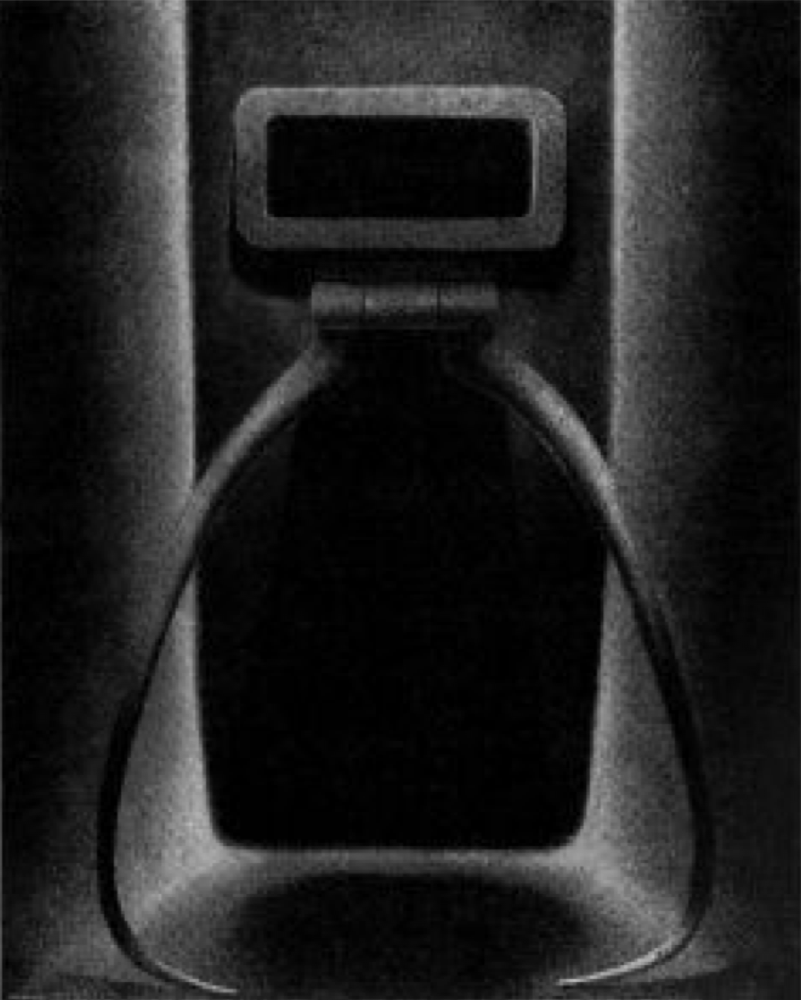
    Passage VII (1970)
  6. HR Giger: The first passages paintings resulted from a series of vivid dreams. Most of the time I would find myself in a big white room without any doors and windows, where the only exit leads to an all powerful evil, which was represented by a dark, metal opening obstructed by a metal clamp. I often became firmly stuck when I tried to pass through this opening. To my misfortune, the exit at the end of this long tunnel, which could be spotted as a tiny gleam of light. was promptly locked by an invisible force. Now I would be stuck in the tube with my arms pressed tightly against my body and could not move forward or backwards, and I felt as if I was running out of breath. The only solution was to wake up. I then drew some of these imaginary PASSAGES (I-IX) and since then have been spared the birth nightmare. But the PASSAGES, which have become for me the symbol of Becoming and Passing with all stages of lust and suffering, have not let go of me to this day (Giger's Film Design, p10)
  7.  C J Fifer: I suffer from bad dreams, and use them to create my own art. Of all the night terrors you've had, is there one particular nightmare that has stuck with you .
    HR Giger: There are many. In a lot of cases, recurring dreams eventually led to the creation of some of my most poignant works. I frequently wrote about this in my books, such as the Necronomicon. An exampled of this is the 'Passagen' series of painting of the late 1960s and early 1970s. (Bizarre magazine, 2013 p67)
     
  8. Giger: ... sometimes I have these images, while I was painting the Passage, it was okay, but when I get into unpleasant situations, I suddenly find myself in some kind of masonry in which I get stuck and it's getting hot or I'm sitting outside and I have to get inside... (Through the eyes of Giger, video interview)
    Passage VIII
  9. HR Giger: A dream where I can’t get enough air, that’s frightening. Or the kind of dream where I was stuck in a grave or something like that, that was frightening. But later I developed these passages paintings [Passage I-XXX] and they were very good for that. I got some sort of relief. I got no more bad dreams when I painted these passages. It was helpful.
    Conor Creighton: Does that happen often?
    HR Giger: No, not often, but I did the right thing because at the time these passage dreams were ruining my work. It was the right thing to make me feel better.
    (conorcreighton.wordpress.com/2009/12/08/) & (www.vice.com/)
  10. Giger found inspiration for his art in the night terrors he experienced beginning in his childhood. Painting his dark and disturbing visions provided a kind of self-therapy: (www.cgsociety.org/ 2 May 2013)
    Passage IX (1971/1972)
  11. HR Giger: I don’t have these dreams anymore. Well, maybe I do but I don’t make sketches of them. I draw some of the things I have dreamt. For example, there’s a rather unpleasant dream where I am stuck in a tomb and the only way out is a very narrow passage. There are huge stones and I am totally stuck. I cannot move at all. So terrifying, claustrophobic nightmares. I made some drawings of them, and every time I look at them, it puts me back into that terrible situation. Looking at these pictures bothers me so much, that I don’t look at them anymore.” (www.cgsociety.org/ 2 May 2013
  12. Interviewer: Do you get your inspiration from dreams, and does your art work reflect your dreams.
    H R Giger:
    My dreams are usually very realistic, there aren't any figures like the ones in my paintings. But I for example used to have an unpleasant dream, I always tell people the same thing but it happens to be true; a long time ago I used to have nightmares, they were, I was stuck in a kind of oven with my hands drawn up and I couldn't get any air, and that was probably a dream, which, from my mother... mine was a difficult birth, you see, that's what my mother told me, I didn't want to come out and of course I couldn't get any air and that happened again and again, and then from far away, I would see a light and then it would become dark again, couldn't get any air and so on, and these unpleasant dreams stopped when I began to paint those passages which actually represent that condition. At the time, I didn't notice that at all, but well it's turned out to be true because I haven't had any of those dreams since then.
    (report from unused conversation with H R Giger for Alien Evolution) 
  13. Sonic Seducer : Die Bilder, die sie malen, haben sie diese vorher geträumt?

    Sonic Seducer: The pictures that you paint, you have dreamed about this before?

    HR Giger: Nein, meine Traumwelt ist sehr realistisch. Es gibt dort sehr viel bergigen Wald, es ist dort ziemlich warm, es gibt einstöckige Häuser und Gebäude, manchmal mit geheimen Durchgängen. Ich bin dort meistens allein und ganz komisch. Oder ich fahre Auto in einer Gegend, in der ich mich auskenne. Mein Traumreich ist nicht besonders phantastisch. Ich habe früher häufig Träume gehabt, in denen ich in einer engen Röhre steckte und irgendwie keine Luft bekam. Diese Röhre war am Ausgang immer von einer Art Sicherheitsnadel verschlossen. Dieser Traum kehrte in ähnlichen Varianten immer wieder. Nun, meine Mutter hat mir erzählt, daß ich eine sehr schwere Geburt gewesen bin. Die Sicherheitsnadel wird wahrscheinlich die Geburtszange oder etwas ähnliches symbolisieren. Die Geburt muß wohl für mich ein derart schreckliches Erlebnis gewesen sein, das sich in meinem Unterbewußtsein verankert hat und erst im Laufe meines Lebens zum Vorschein kam. Dies war einer der wenigen Träume, die mit in meine Bilder eingeflossen sind. Heute habe ich diesen Traum nicht mehr.

    HR Giger: No, my dream world is very real. There are a lot of mountainous forest, it is quite warm there, there are one-storey houses and buildings, sometimes with secret passages. I am there mostly alone and it's very funny. Or I drive a car in an area in which I am familiar. My dream world is not particularly fantastic. I used to often had dreams in which I was stuck in a narrow tube and somehow could not breathe. This tube was closed at the exit always by a kind of safety pin. This dream came in similar variants repeatedly. Well, my mother told me that I have been a very difficult birth. The safety pin is likely to symbolize the forceps or something similar. The birth must have been such a terrible experience for me, which has been anchored in my subconscious and only in the course of my life came to light. This was one of the few dreams that have been incorporated with in my pictures. Today I no longer have that dream.

    Sonic Seducer: Als Embryo wächst man im Mutterleib heran und ist mit seiner Mutter praktisch bis kurz nach der Geburt als Säugling verwachsen. In ihren Bildern sind fast immer alle Gestalten, Symbole und Gegenstände direkt mit einander verwachsen und stellen ein gesamtes, organisches Gebilde oder sogar eine Einheit dar. Glauben sie, daß Malen eine Art Therapie für dieses prägnante Schreckenserlebnis in frühester Jugend gewesen sein könnte, mit dem sie immer wieder in ihren Träumen konfrontiert wurden?

    Sonic Seducer: As one embryo grows in the womb, and is convenient to briefly united with his mother after birth as an infant. In its pictures all shapes, symbols and objects are almost always grown directly with one another and make a whole, organic structure, or even a single entity. Do you think that painting could have been a kind of therapy for this incisive horror experience in early youth, with which they were confronted again and again in it dreams?

    HR Giger: Darüber habe ich mir eigentlich noch nie Gedanken gemacht. Aber wenn ich mir es so recht überlege, ist das sicherlich möglich. Es ist auf jeden Fall ein interessanter Ansatz, der mich vor einigen Jahren zum Grübeln angeregt hätte. Heute bin ich jedoch froh, daß ich diesen Traum nicht mehr habe, da ich jedes mal schweißgebadet aufgewacht bin.

    HR Giger: About that I have never thought, actually. But if I consider it so surely, this is possible absolutely. It's definitely an interesting approach, which would have inspired me a few years ago to brood. Today, nevertheless, I am glad that I have this dream no more, because I have woken every time bathed in sweat. (SonicSeducer_3_99)
  14. Carmen Giger: He always said he had a really difficult birth, that he had to be pulled out using forceps and that he could remember it. It started with these dreams of a huge room with just one opening. He’d panic and want to escape through this small tunnel that got continuously tighter but this paperclip-like object blocked his exit and he couldn’t get back to the room because his arms were tied. Around 65, these things came up again and I could feel that panic in him. We had a psychiatrist friend, Dr Stanislav Grof, who often talked with Hans and was very much interested in the Birth Trauma because he claimed it was comparable to encountering one’s psyche. In Giger’s case, his difficult birth was always in him. Through painting passages [Passages I-XI, 1969] he said he could go over a lot of claustrophobic pains and panicked feelings he still had. (https://www.anothermanmag.com/life-culture/10934/alien-film-hr-giger-ridley-scott-anniversary-artist-carmen)

H R Giger

H R Giger's art.

Leading from 
HR Giger with his Alien 3 beast. (source: http://fantasticvisions.net/)


a) Artwork

Prometheus drawings 22 to 27 & 30:  Deck Elements (2011)

Prometheus drawing 14: Fifield Monster  (22nd February, 2011) 

Prometheus drawing 12: Babyhead (23rd February, 2011) 

Prometheus drawing 0-4: Alien Beast for Prometheus (16th February, 2011) 

Xenoerotica drawings (2005)

Unused dragon sketch for "Reign of fire" (2000)

The Windowlickers I, II & III (1999) (Homage to Chris Cunningham video) 

Aquatic Super Facehugger (1990)

Bambi-burster  (1990)

Alien 3 beast (1990)

  
618: Carmen I (1988/1989) (Radio Times illustrations for the Proms 88)

610: Pump Excursion  (1988)), (Die Wittwe des Rennfahrers work 612 (1988) 620 & 620b (1989) (Gun played as musical instrument as if by an American-Indian)

607: The Net II (1988) (References "Coping with Cuts" Radio Times illustration from) 

597: Biomechanical landscape I (work 597) (1987) (Kokopelli playing a flute in a drowned world where there was a dog that ran for president)

591: The Net I  (References "Coping with Cuts" Radio Times illustration from) 
 
585: The Saxophonist(1986) (Radio Times Eurovision Song Contest performers)

583: Biomechanical Landscape I (1984 -1986) (Fire Engine Scene from The Eternals #16 and Giedi Prime from David Lynch's Dune)

580: Power and powerlessness of a relationship (1985) (Radio Times illustration by Wendy Hoile from 10th March 1984 for "A whimper to a grave" BBC Radio play)  

Untitled drawing (1985) (Echoes of Life Cycle Hieroglyhics and Alien Monster III)

562: Evolution Chinoise  (1981-1984) (The China Concerts meets Alice in Wonderland meets Museum of the Year)

561: Trumpets of Jericho (Tomita's Kosmos album cover)  

518: Future Kill II

517: Future Kill I

515: Victory IV (Felicity Kendal presenting Disney Time, holding Mickey and Minnie mouse)

513: Demon  (1978) (William Hieronyeamus Ereborsch (Mount Erebor +William Onyeabor + Hieronymus Bosch)+ Oni + Heikegani Crab + Arnold Böcklin's Die Toteninsel III +  The Big Top)

512: For Judith  (Crucifixion scene merged with a racing car being inspected by fans)

509: Alien Heads (1983) (Villemot's Perrier... C'est Fous 1979)

508: Biomechanoid with three heads (1983)  (references Radio Times 2nd-8th June 1979) 

500: Totem  (1983) (Christ taken down from the cross from Radio Times)   

496: The Tourist VIII Two aquatic aliens (1982) (Boy on his fathers shoulders on Charles and Diana's wedding day and 2001 A Space Odyssey Illustration from The Radio Times)
 
492: The Tourist IV (Tentacled Creature) (1982)

487: Anima Mia (1980/81)  (Swans Reflecting Elephants of Celebes amongst Guernican debris of an automobile giving birth to a blind horse biting a telephone)

476: N.Y. City XVI (1981) (Jackson Pollock's "Pasiphae' and Lord of the Rings illustration from The Radio Times)

472b: Debbie II (1981) (Queen of Akku-Akku-Punk-Ture!)

472: N.Y. City XXII (work472) (1981) (Radio Times illustration "Australia: A Long Way Home", Rolls Royce Chief David Plastow with Rolls Royce, Boney M and Battlestar Galactica's The Tucana singers )

470b: Debbie (1981) (Queen of Akku-Akku-Punk-Ture!)

470: N. Y. City XX "Ein Stadt Sucht einen Mördor"  (1981)
 
467: N.Y. City XVII Crowley (1981) (Phallic buildings turning into Darth Vader merged with Nommo pretroglyph)  

464: N. Y. City XIV Factory (1981) (Ballard photo collage from Radio Times for Harley Cokeliss' Crash) 

459: N.Y. City IX Jahreswechsel (1980-1981?)  ( Illustration by David Smith from 23rd february-1st March 1980 edition of Radio Times)

452: N.Y. City II Lovecraft over N.Y. City (work 452) (1980)
(Mummification ritual merged with American TV viewers, a woman adjusting TV, a family of foxes frames with Judy Garland's love photos)

444: Biomechanic Mia (Egyptian Style) (1980)  (Lemurian train bomb from Jack Kirby's The Eternals #16 , July 1977  and WHSmiths Christmas Presents for Dads, 1980)
 
 
437: Beaubourg  (1980)  (Arctic camera man and penguin from Twelve Flags South and Kiwi from Zoo Time transform into the Beaubourg centre)

434: Biomechanical landscape (sack) (1980) (Tomita's Firebird album cover and merged with illustration for Bellamy Down Under in Radio Times)

433: ZDF (1980)  ( The ZDF television channel is a front for a Zeta Reticulan conspiracy, while the Pakal Votan Tomb lid rocketeer continues to explore the galaxy merged with starmap from Temple of Hathor via the cover of Tomita - Bolero 12" cover,  reaching to the Betty Hill starmap via the Drak space station along the Risk Business, going over to Dali's "Daddylonglegs of the evening- hope!" and Morton Subotnik, John Cage and Frank Zappa on the crest of the Californian new wave, before heading back and pairing the Betty Hill starmap with the Dali painting via"Dogman in Doktor Oktorpus Nonplussed"leaping toward Joost Schmidt's Bauhaus poster via "Beat Extra")

431: Biomechanic Metempsychosis (1980) (Radio Times cover for Doomwatch and Doctor Doom)
 
424: Erotomechanics IX (Fellatio)) (1979) (Publicity image for The Burke Special in The Radio Times, (19th July 1973)
 
423: Erotomechanics VIII (1979) (Radio Times illustrations for "I cracked it" featuring trains on tracks, The Royal International Horse Show jumping and Gustave Courbet's L'Origine Du Monde)

422: Erotomechanics VII (1979) (Bedroom practices with alien head in the manner of Pakal Votan Tomb lid framed by Dali's Portrait of Portrait of the Viscountess Marie-Laure de Noailles) 

418: Biomechanical Landscape III "Trains"(1979) (Trains merged with Radio times cover photos for villages of the Hindu Kush and Into the Unknown )
   
417:  Biomechanical Landscape II (work 417) (1979) ( Pollock's "The Moon-Woman Cuts the Circle" merged with "Bald Woman with Skeleton" and woman holding a long printout wrapped around Inspector Clouseau's head)

415: Ugly  (1979) (The Celestial's giant spacecraft from The Eternals #2 )

414: Cabinet door for Mia (1979) ( The Blackpool Tower Circus illustration for The Radio Times 24/8/74 BBC1 and Billy Smarts Children Circus illustration (for the 9 january 1978, Radio Times) by Alan Cracknell)

413: Biomechanical Landscape  (1979) (Lovecraftian monstrosities in the form of Sea horses, masks, perhaps people sneezing  following the interlinking structure of Jackson Pollock's "mural", Sea horses, masks, perhaps people sneezing)

412: Vlad Tepes  (1978) (Wifredo Lam's Femme Cheval (1957) merged Steiner-Prag illustration from The Golem and Pluto the dog turned into something inspired by Dracula movie, guest starring the banana splits and Young Virgin Auto-Sodomized by the Horns of Her Own Chastity)

411: Landscape (1978) (Geometrical design from November 1978 Radio Times cover )
 
410: Alien Monster V (1978)

409: Alien Monster III  (1978) (Painting from"The Creeping Flesh" appears to reference Max Von Moos' "Devil's Kitchen (or Stalingrad)",  and elements from both merged with the Tomita "Bermuda Triangle" album) 

408: Alien Monster IV (1978) (Treasures of Galaxatanic Lemurian train bomb-Ballardrog armed with serpentine zigzag tongue of fire and flailing daddy longlegs of the evening-hope at an exhibition) 

407 Alien Monster II (1978) (Louis Jourdan as Count Dracula with surrounding architecture transformed into creepy crawlies)
 

404: Landscape (1978) (Cyclops triskellion German and British album covers for Tomita's Snowflakes Are Dancing, decorated with spikes from German WW1 military helmet)

403: Space Trip 2  (1978) (Looney Tunes Tasmanian devil whirl tunnel for a train set)

402: Space Trip I  (1978) (Star Wars poster with Darth Vader head with eye lens bearing an eight configuration.)

401: HP Lovecraft's Visit (1978) (Radio Times Doctor Who photo collage page from 7th May 1970)
 
397: Landscape with Wreck  (1978) for Alien

393: Cocoon (1978) for Alien (Fondu man)
 
388: Egg silo interior version II (1978) for Alien (Pink Panther painting with paint pallet in hand and the Oyster and the Carpenter with Oysters)
 
386: Egg Silo Interior version I (1978) for Alien
 
386: Alien corpse detail (1978) for Alien  (Alien corpse after photo of Freddie Young)

385: Landscape  (1978) for Alien (Landscape with Alien corpse that might as well be Christ taken down from the Cross)
 
384: Life Cycle Hieroglyphics  (1978) for Alien (Nut the sky goddess and Ron Cobb's Alien Temple artwork intersecting with  Ernst Fuchs' Triumph Of The Unicorn via William Onyeabor's "Crashes in Love" and Biomechanical Landscape (work 312)
 
380: Alien corpse detail (work 386) (1978) for Alien (Photo of cameraman Freddie Young) 
 
380: "Pilot in Cockpit" (work 380) (1978) for Alien (Henu Barque, The Walrus and the Carpenter with empty oyster shells) 
 
380:  The Space Jockey ( Pilot in cockpit as seen in Alien)( 1978) (Henu Barque meets Moebius' Arzac's bird and Dali's Martian Dali equipped with a double holoelectronic microscope, with echoes of sculpture of giant pilot in space capsule from The Eternals and the Hydra)

378: Egg Silo Exterior  (1978) for Alien (Breast shaped ruins via R'lyeh via Wyndham Lewis' "A Battery? shelled" )  
 
374: Wreck (1978) for Alien (Was-Sceptre at the V&A merged with a barge of a million years by way of a sea lion with stingray gills and Pink Panther riding on a shop of the desert)
 
Alien stage III version 4 ( no work number) (1978)

372/373: Alien stage III version 3 ) (1978) (Alien design by way of inner brain parts and Lady Penelope's pink Rolls Royce)

370/371: Alien stage III version 2 (work 370 & 371) (1978 ) (Alien by way of Jack Kirby's The Terrible Totem, the side view evolves by way of a portrait of JG Ballard based on Autumnal Cannibalism (the photo should be called Autumnal Canniballard) and then an alien being concept for 2001 A Space Odyssey.

369: Alien stage III version 1 (1978) (Alien design by way of Wifredo Lam's Femme)

368: Alien II chestburster concept (work 368) (1978) (Three studies for figures at the base of a crucifixion via racing cars and horse rider for World of Sport in the TV Times)

359: Illuminatus II (1978) (Illuminatus trilogy via album cover of Tomita's planets)

358: Illuminatus I  (1978) (Illuminatus trilogy... etc )
 
356: Biomechanic landscape (1977) (Buried impression of a Saxophone)

355: Stillbirth Machine III (1977) (Eraserhead meet Fuchs' "Samson finds the carcass of the lion")

350: Homage to Bocklin (1977) (Boecklin's Island of the dead) 

344: Mirror Image (1977) (Robert Venosa's Enlightenment)

342: "Deathbirth Machine II" (1977) (Impressions of the Henu Barque)
 
341: Witches Dance  (1977) (Max Ernst's Robing of the Bride dancing around Marcel Duchamp's Fountain merged with Otto Dix's The Skat Players)

331: The Spell IV (1977) (Lang's Metropolis and Melies' 20,000 Leagues under the sea)
 

328: Space I (1976) ( Fisher Price Airport and Jet Plane merged with UFO Sky Diver connected with submarine and whales)
 
324 Satan I (1977)
 
320: The Spell III (1976) (Takeda Shingen's head dress) 

319: Biomechanic Landscape IIa (1976) (Scenes of the Ghettos from Meyrink's The Golem)

318:  Necronom IX (1976) ( Exorcist's Pazuzu head meets The Fly and  Dali's "Daddy Longlegs of the Evening - Hope!" Astrostation)

317: Necronom VIII  (1976) ("Sleep" meets Olmec "Man In Serpent"hydrocopter )

316: Necronom VII (1976)  (Elements of Otto Dix's Skat Players and Viking helmet becomes the Ice Warrior from Doctor Who)

313 Stillbirth Machine (1976) (Ernst Fuchs' Observatorium and Joseph's Technicolour Dream Coat)
 
312: Biomechanical Landscape (1976) (West Australian cave art featuring abstract human figures in ritual dance and Ernst Fuchs Triumph of the Unicorn)

306: Necronom VI (1976) (Baron Harkonnen with leaf blower connected to groin while the inspector is attacked by an octopus)
 
304: Necronom V (1976) ( Microtron combines with motorcyclist female representative of Pink Panther-Pakal Votan's carrying a Maoi Kava-Kava waiters friend in a papoose carrier,  flying a rocketship that transforms into a family camper torn apart by a premonition Spanish Civil War offers proof to ancient alien enthusiasts that extra-terrestrial visited Earth thousands of years ago)

303: Necronom IV  (1976) (Mobile exploration lab echoing of Mummification Ritual as the Pink Pantherzuzu via Saturner-Prag's Golem eating his son meets the Wadjet by way of Fuchs "Angel of death" inducing magic form of Napoleon’s Nose, Transformed into a Pregnant Woman, is Strolling His Shadow with Mickeymouselancholia amongst Original Ruins  )

302/302a: Necronom III and Necronom IIIa (1976) (Suicidal donaldaffy duckopelli in the eye of Leflyathan diving Celebellephancaster bomber gun turret Biotron)

301: Necronom II (1976) (The Watchers of Cirith Ungol, Egyptian god Khepri, King Tut's Desert Glass Pectoral and Mickey Mouse and the Stratastation)

300: Necronom I (1976) (Ernst Fuchs "Vision" 1953,  Dinky Captain Scarlet SPV and Dali's Portrait of Picasso )

298a: Biomechanic Landscape II (1976) (Oscar Wilde(?),Motorbike(?),Fuseli's Nightmare and ) Sacred palm and wild goat lentoid from Palaeokastro in Crete )

297: Biomechanic Landscape I  (1976) (Holbein's Henry VIII, a cigar guillotine and The Nativity by Guido da Siena, 1270s)

296: Mordor XII (1976) (Flu and steam inhaler (?))

295: Samurai (1976)  (Sommelier Knife) 
  
288: Landscape XXXII  (1975/76) (Willy Pogany's illustration from The Song Celestial (Bhagavad Gita))

283: Mordor VII (1975) (Family of Marsupial Centaurs giving birth to a moon wearing a nightcap while sowing at the Master's Grave)
 
282: Mordor VI(1975) (Nommo manifestations through squid like sea-monks turning into a woman's dress  and sea-bishop that's dried out Sting-Ray trimmed to a roughly humanoid form, turning into Kubin's The Brood who penetrates the woman's behind with a black sausage doubling as a pneumatic tube capsule )
 
281: Mordor V ( (1975) (Nommo from Sirius with catfish like head disguised as a japanese dumpling, imbedded in the Clock house that transforms into sausages , a sea serpent slain by Perseus as the mermaids purse yolk transforms Nommo disguised as an Andromedan buttock face puffer fish moonhopper haggis blowing like the north wind.)

280: Mordor IV  (1975) (Fisher Price Teacher Clock merges with the Enigma of William Tell/Jethro Tull as a spectral moon playing an aqualung, echoes of Man Apes and what's neither a Manitou, a Manatee or Manta Ray but a sea lion with sting ray gills and mouth) 
 
279: Mordor III (1975) (Spectre of H P Lovecraft or even Beardsley or merged with that of the world of sea monkeys?) 

278: Mordor II  (1975) (Hans Bellmer doll merged with statuette of a seated Cthulhu held in hands and the cover of the short story collection "The Inner Landscape" featuring J G Ballard as one of the authors)

277: Mordor I (1975) (Sheath of the spear of destiny transforms into a male member, elongated limbs and corpse in dark cutaway space. An oval slants down the left. )

270: Lord of the Rings II  (1975) (Max Ernst's Eye of Silence by way of J G Ballard's The Crystal World)

274: A. Crowley (The Beast 666)  (1975) (Ideas from Crowley's Snowdrops from a Curate’s Garden, photo of prisoners from the Buchenwald's Nazi concentration camp 1945 etc.)

273: Landscape XXXI (1975)

271: National Park (1975) (Uterine explorations by way of Jean Cocteau's "Reveries of Opium" 1938 (which was inspired by Dali-s The Great Masturbator (1928),  Fuchs "Triumph of the Sphinx" and Dado's Tribute to Cazotte) 

264: Passage Temple Way of the Magician (work 264) (1975) (Page from Jack Kirby's comic book story "The Demon" showing huge idol)

263:  Passage Temple Death (1975) (Page from Jack Kirby's comic book story "The Demon" showing huge idol)

262: Passage Temple entrance (work 262) (1975) (Fisher Price Cot Activity Centre, Tutenkhamun's Desert Glass Pectoral and star map from the Tomb of Pharaoh Seti I))   

261: Passage Temple (Life)  (1974) ( Ernst Fuchs' "Triumph of the Unicorn" (1952,  Jason Blood's artifact collection from "The Demon" #8, April (1973 ) by Jack Kirby and skinless lemur drawing by Lee Brown Coye (1973))

255: Biomechanoid III,  (1974) (Inhaling the odour of Tah-Di-Isis)  

247: Landscape XXVII (Variations on the illustration by Lawrence Ratzkin for J G Ballard's Crash)   

238: The Spell II  (1974) (Wifredo Lam's Les Noces, Relic from Jack Kirby's The Demon, Mad magazine fold-in, Mike Oldfield's Tubular Bells and Virgin record label)

237: The Spell I  (1973-1974) (Monolithic vessel inspired by the Cristo Redentor of Rio De Janeiro with echoes of "Jesus Christ Superstar" merged with Egyptian dwarf god Bes journeys into the stargate)

221: Friedrich Kuhn II (1973)
 
220: Friedrich Kuhn I (1973)

219: Landscape XX (1973)  (Pizza)

216: Landscape XIX (1973)

214: Landscape XVIII (1973)   (Pizza)

210: Aleph (1972-1973)  (Doctor Who and The Curse of Peladon with an air of "The wind from nowhere")

209: Landscape XVI (1972)  (Orgy transforming into Cyberman by way of a bitches brew)
 
208: Landscape XV (1972-1973)  (Pasta) 

207: Landscape XIV (1972-1973)  

203: Landscape X (1972)  (Military service shooting practice and Gaia) 

190: Chiquita (1972)  (Chiquita bananas)
 
189: Super Star (1972)

181: Assuan (1972) (Picasso's Guernica by way of Day of Judgement and Picasso's Guernica and Nourlangie rock art in Kakadu in Australia)

147: Felt Pen Drawing (1971)  (biomechanised Cuban doomsday weapon from Our Man In Havana)

112-113, 116-120, 145: Passages I-IX (1970 approx,  ) (Dreams of being trapped in a room)
  
93b: Swiss Made Extra-Terrestrial suit (1968) (Giger's "woman with child" transformed into something other than a cyberman from Doctor Who.)

93: Homage To S.Beckett  (1968) (abstracted Dali's The Great Masturbator)

72: "Mother with Child" (1967) references Brusilov's "Des Visiteurs Du Cosmos" illustration?
 
71: Astro Eunuchs (1967)

69: Die Atom Kinder  (1967-1968) (Cold War feelings turn into Cyberpunk)


b) The artist's life
  1. The Mummy at the museum
  2. HR Giger discovers the airbrush

c) Works as series
  1. The Passage Temple Environment
  2. Necronom series 
  3. Mordor series
  4. The Spell i, ii, iii & iv 
  5. Passages I-IX
d) Discussion about Giger's work
  1. Author and radio presenter Richard Hoagland chats about Alien and HR Giger on his show "The Other Side Of Midnight"
e) Dreams
  1. Ernst Fuchs type Demon
  2. Shaft Dreams
  3. Passages Nightmares 
  4. Military Service And School dream memories 
f) Influences and people referenced
  1. Gerry Anderson (TV and film producer, director and writer)
  2. Sergius Golowin (Researcher of folklore and esotericism)
  3. JG Ballard (Writer)
  4. Edward Burne-Jones (19th Century British Symbolist artist) 
  5. Salvador Dali (Surrealist artist)
  6. Jean Delville (Symbolist artist) 
  7. Walt Disney (American entrepreneur, animator, voice actor and film producer)
  8. Otto Dix (German painter amd printmaker)
  9. Max Ernst (Surrealist artist)
  10. Frank Frazetta (Science fiction and fantasy artist.)
  11. Ernst Fuchs (Artist who co-founded the Vienna School of Fantastic Realism)
  12. James Gleeson (Australian Surrealist)
  13. Jack Kirby (comic book writer/illustrator)
  14. Mati Klarwein (Painter)
  15. Wifredo Lam (Surrealist and cubist painter)
  16. Max Von Moos  (Painter)
  17. Gustave Moreau (Symbolist) 
  18. William Onyeabor (Synth-Funk pioneer) 
  19. Gilles Rimbault (French artist)
  20. Hugo Steiner-Prag's drawings for Meyrink's The Golem (Illustrator)
  21. JRR Tolkien (British fantasy author)
  22. Isao Tomita (Japanese music composer)
  23. Bernard Villemot  (French poster artist)
  24. Ling Chi execution photos 
  25. Giger Lexicon (still in development)
  26. H. R. Giger and the Zeitgeist of the Twentieth Century by Stanislav Grof, M.D., Ph.D. (http://www.primal-page.com/grofgige.htm)   
  27. Grof on Giger: The Transpersonal Nature of Art, Inspiration, and Creativity (Part 1 of 2) 
  28. Grof on Giger: The Transpersonal Nature of Art, Inspiration, and Creativity (Part 2 of 2)
  29. Military service and School memories,  
  30. Out of body experiences 
  31. Ancient Egyptian mysteries
  32. Petroglyphs
  33. Tale of the Scarecrow 
  34. Brothers Grimm's "The Story of a Boy Who Went Forth to Learn Fear"
  35. Saint Stephen's Catacombs
  36. The architecture of Cambodia
  37. Giger inspired by mother's hospitalisation and metal hip plates
  38. People's treatment of animals
  39. Cocteau's Beauty And The Beast 
  40. Hieronymus Bosch 
  41. Micronaut toys 
  42. Fisher Price toys
  43. The TV series Doctor Who
  44. Radio Times images 
  45. Giger's use of opium
  46. The Pink Panther 
  47. Frank Frazetta
  48. Giger's biomechanoid world. (still in development)
g) See: Studio environments
  1. H R Giger's work studio during Alien at Shepperton Studios, 1978 
  2. H R Giger's work studio in the corner of a film studio at Shepperton, 1978 
  3. H R Giger's studio moved into the hut in the car park, 1978
  4. H R Giger's studio moved to the Art Department, 1978
  5. HR Giger's studio at home in Zurich in Switzerland
h) Record covers... etc
  1. Dead Kennedys' Frankenchrist and Giger's Penis Landscape
  2. The "Futurekill" poster artwork 
i) Echoes of Giger
  1. Virus (2016) film poster references Giger's ELP XII?
  2. Cronenberg's Mugwump from Naked Lunch